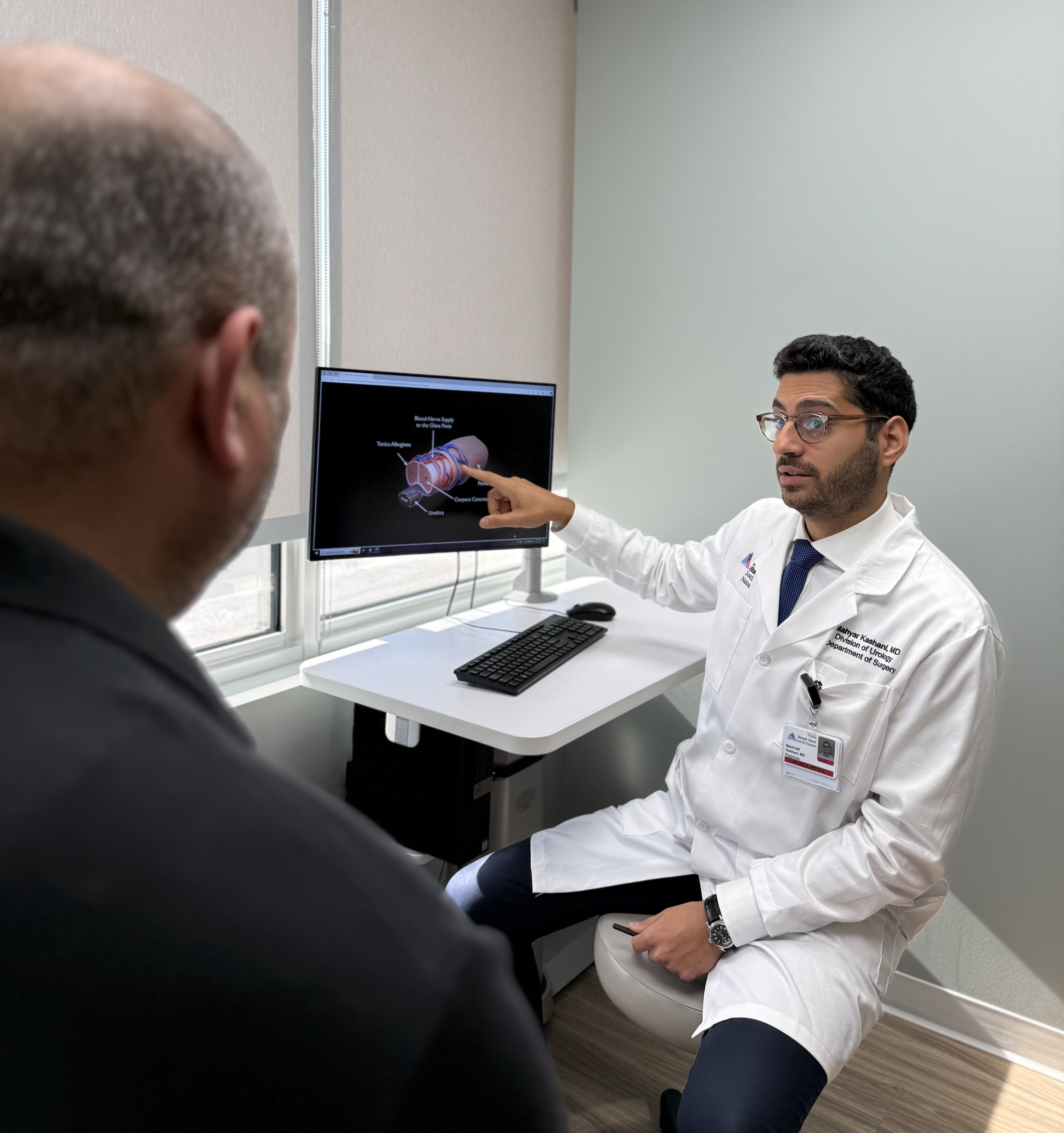
Urinary Urgency, Frequency & Urge Incontinence — Causes, Diagnosis & All Treatment Options
The sudden urge to urinate that stops you mid-conversation. Rushing to the bathroom and not always making it in time. Going so often you plan your entire day around bathroom locations. This is Overactive Bladder — and it is not something you simply have to live with.
Overactive Bladder (OAB) is a condition where the bladder muscle contracts involuntarily — sending urgent signals to urinate even when the bladder isn't full. It affects roughly 1 in 3 men over 40, significantly disrupts daily life and sleep, and is highly treatable with the right approach.
Dr. Kashani treats OAB comprehensively — from first-line medications to bladder Botox injections for patients who haven't responded to oral therapy.
OAB is not just an inconvenience: Chronic urgency and leakage affect confidence, relationships, sleep, and quality of life. It is a real medical condition with excellent treatment options at every stage.
OAB occurs when the detrusor muscle — the muscle that makes up the bladder wall — contracts unpredictably and too frequently, creating the sensation of urgency even when the bladder isn't full. Unlike BPH, which is a structural obstruction problem, OAB is a neurological and muscular problem. The two often coexist, which is why a complete evaluation is important before starting treatment.
OAB primarily causes irritative (storage) symptoms. If your symptoms are mostly obstructive — weak stream, straining, hesitancy — that points more toward BPH.
A sudden, strong, difficult-to-control urge to urinate. The defining symptom of OAB. Can come on without warning and is not always relieved by urinating.
Urinating more than 8 times per day. Most people urinate 6 to 8 times in a 24-hour period — going more frequently is a key OAB indicator.
Waking 2 or more times per night to urinate. Severely disrupts sleep quality, daytime function, and in older men, significantly increases fall risk.
Leaking urine before reaching the toilet when urgency strikes. Not all OAB patients experience incontinence — but when present, it is often the most distressing symptom.
Constantly mapping out bathroom locations before going anywhere. Avoiding situations where a bathroom isn't immediately accessible. A major quality-of-life indicator.
OAB-related nocturia is one of the most underrecognized causes of poor sleep quality in men. Poor sleep compounds fatigue, mood, and cardiovascular risk.
OAB is diagnosed clinically — based on symptoms — but a proper workup rules out other causes (infection, blood in urine, BPH obstruction) before starting treatment.
OAB and BPH often coexist: Many men have both conditions simultaneously. Treating only one may produce incomplete relief. Dr. Kashani evaluates both carefully before making any treatment recommendation.
From behavioral therapy and daily medication to bladder Botox injections
OAB medications calm the overactive bladder muscle — reducing urgency, frequency, and nighttime trips to the bathroom. Several classes are available with different side effect profiles.
Gemtesa is one of the newest and best-tolerated OAB medications available. It works by activating beta-3 receptors in the bladder, relaxing the detrusor muscle and increasing bladder capacity. Critically, it does not cross the blood-brain barrier — meaning it has essentially no cognitive side effects, making it an excellent choice for older men. Taken once daily.
Dr. Kashani often prefers Gemtesa for its excellent tolerability and minimal side effects compared to older anticholinergic agents. Particularly well-suited for older men concerned about cognitive health.
Similar mechanism to Gemtesa — a beta-3 agonist that relaxes the bladder muscle. Well-established with a long track record. Also taken once daily. Can slightly raise blood pressure in some patients, so not ideal for men with poorly controlled hypertension.
A good alternative when Gemtesa is not covered by insurance, with similar efficacy and tolerability.
The older class of OAB medications — still effective but with more side effects including dry mouth, constipation, and potential cognitive effects with long-term use in older adults. Generally used when beta-3 agonists are not tolerated or covered. Extended-release formulations have better tolerability than immediate-release versions.
Use with caution in older men. Dr. Kashani avoids immediate-release oxybutynin in elderly patients due to cognitive risk. Extended-release formulations are better tolerated.
Behavioral strategies can significantly reduce OAB symptoms — sometimes as effectively as medication. Bladder training teaches the brain to gradually extend the time between urination. Fluid management (timing, type, and amount of fluid intake) reduces urgency. Pelvic floor exercises strengthen the muscles that help suppress urgency.
Always recommended alongside medication — the combination of behavioral therapy and medication produces better outcomes than either alone.
Yes — the same Botox used cosmetically is injected directly into the bladder muscle to treat severe overactive bladder and urge incontinence. It is FDA-approved, highly effective, and a game-changer for patients who haven't responded to oral medications.
Botox works by temporarily blocking the nerve signals that cause the bladder muscle to contract involuntarily. A small amount is injected into multiple sites in the bladder wall during a brief outpatient cystoscopy procedure. Results typically last 6 to 12 months, after which the injections can be repeated.
Most patients experience dramatic improvement — significantly fewer episodes of urgency, leakage, and nighttime urination. Many describe it as life-changing after years of struggling with medications that provided only partial relief.
Important consideration: Bladder Botox can sometimes cause urinary retention — difficulty fully emptying the bladder. Dr. Kashani will assess your baseline voiding function before recommending this treatment, and will teach patients clean intermittent catheterization (CIC) as a precaution if needed.
BPH is a structural problem — the enlarged prostate physically blocks urine flow, causing obstructive symptoms like a weak stream, straining, and incomplete emptying. OAB is a functional problem — the bladder muscle contracts involuntarily, causing urgent, frequent urination and sometimes leakage. Many men have both, which is why a proper evaluation matters before starting treatment.
Not necessarily. Urinary frequency and urgency can also be caused by urinary tract infection, high fluid intake, caffeine or alcohol use, diabetes, bladder stones, or less commonly bladder cancer. Dr. Kashani will perform a complete workup to confirm OAB as the diagnosis before starting treatment.
Gemtesa (vibegron) is a beta-3 agonist that relaxes the bladder muscle without the dry mouth, constipation, and — most importantly — cognitive side effects associated with anticholinergic agents like oxybutynin. For older men especially, there is growing evidence linking long-term anticholinergic use to cognitive decline. Gemtesa does not carry this risk, making it Dr. Kashani's preferred first-line choice for most patients.
Results typically last 6 to 12 months. Most patients return for repeat injections once symptoms return. The procedure can be performed indefinitely with consistent results. There is no cumulative toxicity and no development of resistance — each round of injections works as well as the last.
The procedure is performed through a cystoscope with local anesthetic instilled into the bladder beforehand. Most patients tolerate it very well — it is typically described as mild discomfort, similar to a cystoscopy alone. It is done as an outpatient procedure and takes only a few minutes.
Office visits and standard medications are almost always covered. Newer medications like Gemtesa may require prior authorization, but Dr. Kashani's team handles this routinely. Bladder Botox is covered by most insurance plans and Medicare when oral medications have failed. Dr. Kashani's office will verify your benefits before initiating any treatment.
Getting up once per night is considered normal. Waking 2 or more times — called nocturia — is a medical symptom worth addressing. In the context of OAB, it reflects involuntary bladder contractions during sleep. In the context of BPH, it reflects an inability to fully empty the bladder. Both are highly treatable.
Dr. Kashani provides complete OAB care — from initial evaluation and diagnosis through medical management and procedural treatment. He uses a modern, evidence-based approach that prioritizes well-tolerated medications and offers bladder Botox for patients who need more.
Urgency, frequency, and leakage don't have to run your life. Dr. Kashani offers same-week appointments at two Long Island locations.
Mount Sinai Doctors
2 Lincoln Avenue, Suite 102