A Complete Guide — Causes, Symptoms, Workup & All Treatment Options
Peyronie's disease is a condition where scar tissue — called a plaque — forms inside the penis, causing it to bend, shorten, or narrow during an erection. It affects up to 1 in 9 men in the United States.
The plaque itself is not cancerous and is not an infection. It forms inside the tunica albuginea — the tough, flexible sheath surrounding the erectile tissue of the penis. When this scar tissue builds up, it pulls on the surrounding tissue during an erection, causing the penis to curve, indent, or lose length.
Peyronie's disease can cause significant physical and emotional distress. Many men feel embarrassed or ashamed and wait far too long before seeking help. The important thing to know is that this is a recognized medical condition — not something you caused or something you have to live with. Effective treatments exist at every stage.
You are not alone: Peyronie's disease affects an estimated 1 in 9 American men, yet only about 13% ever receive treatment. Most men suffer in silence — but treatment works, and the sooner you seek care, the better the outcome.
The exact cause of Peyronie's disease is not fully understood, but most experts believe it starts with minor trauma or injury to the penis — often during sexual activity — that triggers abnormal wound healing, leading to scar tissue formation instead of normal tissue repair.
Small, repeated injuries during sex — often unnoticed — can trigger abnormal healing. The tunica albuginea does not heal like normal skin; instead it can form a hard, fibrous plaque.
Men with a family history of Peyronie's disease or Dupuytren's contracture (a similar condition affecting the hand) have a higher risk of developing the disease.
Diabetes, high blood pressure, and high cholesterol are all associated with higher rates of Peyronie's disease, likely because they impair normal tissue healing and blood flow.
Smoking is strongly associated with Peyronie's disease. Tobacco use impairs circulation and tissue healing, creating conditions where abnormal scar tissue is more likely to form.
Some medications — including certain blood pressure drugs (beta blockers) and anti-ulcer agents — have been associated with an increased risk of Peyronie's disease.
Recent research shows that low testosterone may impair normal wound healing in penile tissue, contributing to abnormal scar formation. Many men with Peyronie's disease also have low testosterone.
Peyronie's disease typically progresses through two distinct phases. Understanding which phase you are in is critical — because it determines which treatments are most appropriate for you.
This phase typically lasts 6 months. During this time the plaque is actively forming. Symptoms include pain during erections (often the first sign), a noticeable and sometimes changing curve, and a palpable lump or hardness in the penis. The curvature may worsen during this phase.
Treatment during the acute phase focuses on slowing progression, reducing pain, and preventing worsening curvature.
Once the plaque stops growing — usually after 6 to 12 months — the disease enters the stable phase. Pain typically resolves, but the curvature, shortening, or narrowing remains. The degree of deformity at this point is unlikely to change on its own.
Surgical correction is only considered during the stable phase, once the curvature has been unchanged for at least 3 to 6 months. Injections can still be used in the stable phase.
Symptoms vary in severity from mild to severely disabling. The most common symptoms include:
When to see a doctor: If you notice any new penile curvature, pain during erections, or a lump in your penis — see a specialist promptly.
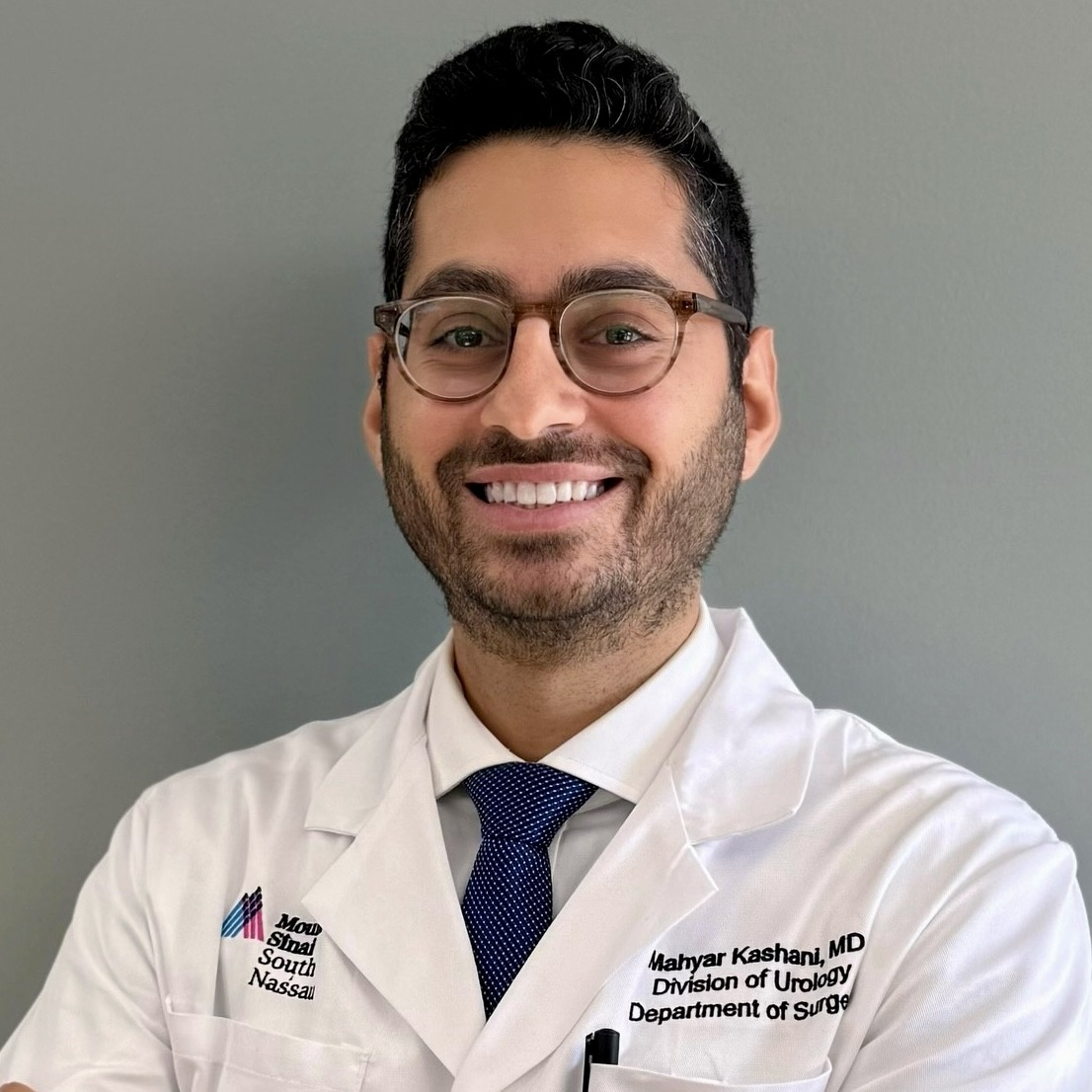
Dr. Kashani uses a comprehensive, evidence-based workup to fully characterize your Peyronie's disease — including the size and location of the plaque, the degree of curvature, and the impact on erectile function. This information is essential for choosing the right treatment.
A thorough conversation about when symptoms started, how they have changed over time, your sexual function, relationship impact, and overall health.
A careful examination of the penis in both the flaccid and erect states to feel for plaques, assess their size and location, and estimate the degree of curvature.
An injection of medication is given directly into the penis in the office to produce an erection. This allows Dr. Kashani to accurately measure the degree of curvature, assess plaque size and location, and evaluate erectile rigidity — all critical information for planning treatment. This is the gold standard for assessing Peyronie's disease severity.
A specialized ultrasound performed after pharmacostimulation to measure blood flow in the penile arteries, identify plaque characteristics (including calcium deposits), and assess for any vascular component to your ED. This helps Dr. Kashani understand whether ED is contributing to your symptoms — and whether it needs to be treated alongside the Peyronie's disease.
Treatment depends on which phase of the disease you are in, the severity of your curvature, and whether you have associated ED. Dr. Kashani tailors every treatment plan to the individual — combining therapies when needed to get the best result.
Xiaflex is the only FDA-approved injectable treatment for Peyronie's disease. It is an enzyme that works by breaking down the collagen in the plaque — softening and dissolving the scar tissue that is causing the curvature. It is given as a series of injections directly into the plaque in the office, followed by gentle manual modeling of the penis.
Xiaflex is typically given in cycles of 2 injections, 1 to 3 days apart, repeated up to 4 cycles. Studies show meaningful reductions in curvature — especially when combined with penile traction therapy. Best results are seen with curvatures between 30–90 degrees.
Verapamil is a calcium channel blocker injected directly into the Peyronie's plaque. It works by interfering with the production of collagen in the scar tissue, helping to soften the plaque and reduce curvature. While not FDA-approved specifically for Peyronie's disease, it has been used by urologists for decades with a well-established safety profile.
Verapamil injections are typically given every 2 weeks for 6 months. They are particularly useful during the acute phase to slow progression and reduce pain, and can be combined with other treatments.
Penile traction therapy uses a medical-grade stretching device worn on the penis for several hours each day. The gentle, sustained tension helps remodel the scar tissue over time, reducing curvature and recovering some of the lost penile length. It is the only non-invasive treatment shown to improve penile length in Peyronie's disease.
Traction therapy works best when combined with injection therapy — the combination has been shown to produce greater improvements in curvature than either treatment alone. Devices are worn for 2 to 8 hours per day over several months. Dr. Kashani will guide you on the correct device and protocol.
Plication is the most commonly performed surgery for Peyronie's disease. The surgeon places sutures on the opposite side of the curvature — essentially shortening the longer side to straighten the penis. It is a reliable, well-tested procedure with high success rates and low complication rates. It is best for men with good erectile function and moderate curvature without significant length loss.
Surgery is only performed once the curvature has been stable for at least 3 to 6 months. Recovery typically takes 4 to 6 weeks. Success rates of 75 to 96% are reported for penile straightening procedures.
For men with severe curvature, significant length loss, or an hourglass deformity, plaque incision and grafting may be recommended. In this procedure, the plaque is cut or partially removed and a graft material is placed to fill the gap and restore penile length and shape. This procedure is more complex than plication but produces better outcomes in the right patient.
This procedure carries a slightly higher risk of postoperative ED than plication, so it is typically reserved for more complex cases. It may be combined with a penile implant in men who also have significant ED.
For men who have both Peyronie's disease and significant erectile dysfunction that has not responded to other treatments, a penile implant combined with surgical straightening is often the best single-procedure solution. The implant provides rigidity while the surgeon simultaneously corrects the curvature — addressing both problems at once.
Dr. Kashani is fellowship-trained in penile prosthetic surgery and uses the Coloplast Titan® inflatable penile prosthesis. Patient satisfaction after combined implant and curvature correction exceeds 90%.
Combination therapy works best: Research consistently shows that combining treatments — such as Xiaflex injections with penile traction therapy — produces significantly better results than either treatment alone. Dr. Kashani designs individualized combination protocols for each patient based on their specific situation.

Answers to the questions Dr. Kashani hears most often — in plain language.
In a small number of cases — perhaps 10 to 15% — mild symptoms improve without treatment over time. However, in most men the curvature persists or worsens without intervention. Waiting too long, especially past the acute phase, reduces your treatment options. Early evaluation is always recommended.
Pain is most common during the acute (early) phase of the disease, especially during erections. As the disease stabilizes — usually after 12 to 18 months — the pain typically resolves on its own. However, the curvature, shortening, or deformity usually remains. If pain is severe or persistent, treatment can help.
Yes — up to 30% of men with Peyronie's disease also develop ED. The plaque can interfere with the blood vessels and erectile tissue, making it harder to achieve a firm erection. Psychological stress from the condition can also contribute. Dr. Kashani evaluates and treats both conditions together.
This depends on the degree of curvature. Mild curves are often not noticed or do not interfere with sex. Moderate to severe curvature can make intercourse painful or impossible — for you, your partner, or both. This is one of the most common reasons men seek treatment, and it is a completely valid reason to do so.
Xiaflex is an enzyme injected directly into the plaque that breaks down the collagen in the scar tissue. The injection is performed in the office using a fine needle. Most men experience mild discomfort, bruising, and swelling after the injection — this is normal and expected. Serious complications are rare. Dr. Kashani will walk you through what to expect at every step.
Penile traction therapy involves wearing a specially designed stretching device on the penis for 2 to 8 hours per day. It is worn while clothed and is discreet. Treatment typically continues for 3 to 6 months. It is not painful — the stretch should be comfortable. It is most effective when started early and combined with injection therapy.
Surgery is considered when the curvature is severe enough to prevent satisfying intercourse, when the disease has been stable for at least 3 to 6 months, and when non-surgical treatments have not provided sufficient improvement. Surgery is highly effective — with success rates of 75 to 96% for penile straightening. Dr. Kashani will only recommend surgery when it is truly the best option for your situation.
Plication surgery (the most common procedure) has a very low risk of affecting erectile function. Plaque incision and grafting carries a slightly higher risk of temporary ED, which can usually be managed with medication. Orgasm and ejaculation are almost never affected by either procedure. Dr. Kashani will discuss the specific risks and benefits based on which procedure is right for you.
The disease itself often causes some shortening as the plaque contracts. Plication surgery may cause a small additional amount of shortening — typically less than 1 cm — since it works by shortening the longer side. Penile traction therapy and plaque incision with grafting are the best options for preserving or recovering length. Dr. Kashani will set realistic expectations at your consultation.
Book a consultation with Dr. Kashani. At your first visit he will do a complete medical and sexual history and a focused physical examination, and schedule an in-office injection test & penile ultrasound to accurately assess your curvature. You will leave with a clear, personalized treatment plan. There is no judgment here — this is a medical condition, and you deserve expert care.
Peyronie's disease requires a specialist — not a generalist. Dr. Kashani completed a dedicated fellowship in Male Sexual Health and Reproductive Medicine at Lenox Hill Hospital in New York City, where he trained specifically in the management of complex penile conditions including Peyronie's disease.
He performs the full spectrum of Peyronie's treatments — from in-office Xiaflex and Verapamil injections, to penile traction therapy guidance, to surgical correction including plication and penile implants. Very few urologists on Long Island have this level of specialized training.
You do not have to live with Peyronie's disease. Dr. Kashani offers discreet, expert consultations at two convenient Long Island locations. Most patients leave the first visit with a clear, personalized plan.
Mount Sinai Doctors
2 Lincoln Avenue, Suite 102